

For a big Insurance Company, we solved the challenge of managing on-the-job development actions linked to the Performance cycle manually — enabling the rollout of consistent learning practices that go beyond content transfer and making learning an integral part of the organisational culture.
The process was handled manually, with all the risks of error, slowness and operational burden this entails. The challenge was to transform it into a structured, fast and governable system.
The Project
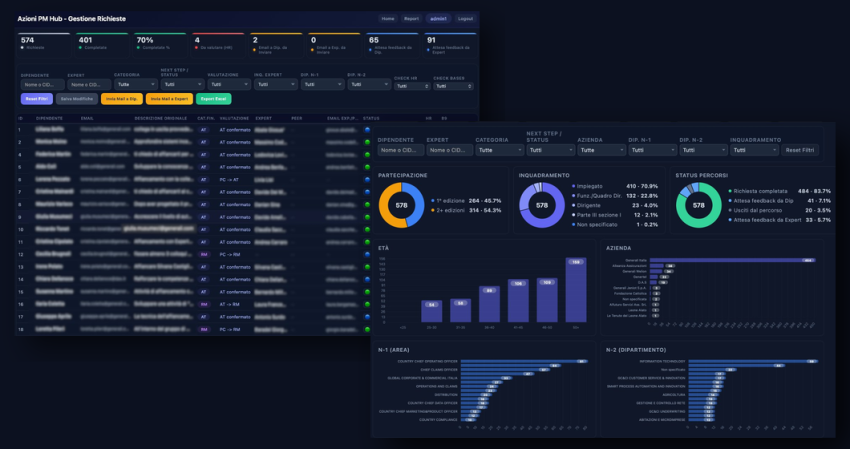
Base 9 designed and implemented a Hub — a custom web platform to manage end-to-end three types of on-the-job development journeys focused on:
- technical knowledge transfer between colleagues
- transfer of key role-interpretation competencies, through a logic of observation and situated learning
- peer coaching between colleagues, with a professional coach supervising the first session
The starting point for all three journeys is the Performance Management feedback conversation — the moment when employees and their managers align on development objectives.
The Platform: What It Does
The Hub automates every phase of a process that previously required manual management:
- Performance Management data import and validation, with AI support to reclassify requested development actions and identify the most suitable journey for each person
- Automatic pair matching — the algorithm pairs participants for each journey according to HR-defined criteria, with full validation and editing capabilities for the HR team
- Automated mass communications — structured sending of invitations, confirmations and reminders via email, with integrated data collection and automatic database updates
- Real-time monitoring — dashboard showing progress status for each pair, with filters for data deep-dives
- Dynamic reporting — data extraction on specific target groups, with Excel export for customised analysis
The HR team retains full governance of the process at every stage: they can intervene on individual cases or entire population segments, manage exceptions and oversee overall progress from a unified control panel.
Results
- Over 1,000 people involved across the three journeys
- Capitalisation of the know-how of nearly 400 internal experts
- Fast adoption and onboarding: 50% of journeys confirmed within 2 days of the mass invitation send; 70% within 4 days
- Significant reduction in operational workload for the HR team (More than 1,300 emails sent from the platform to 200 emails sent by HR)