

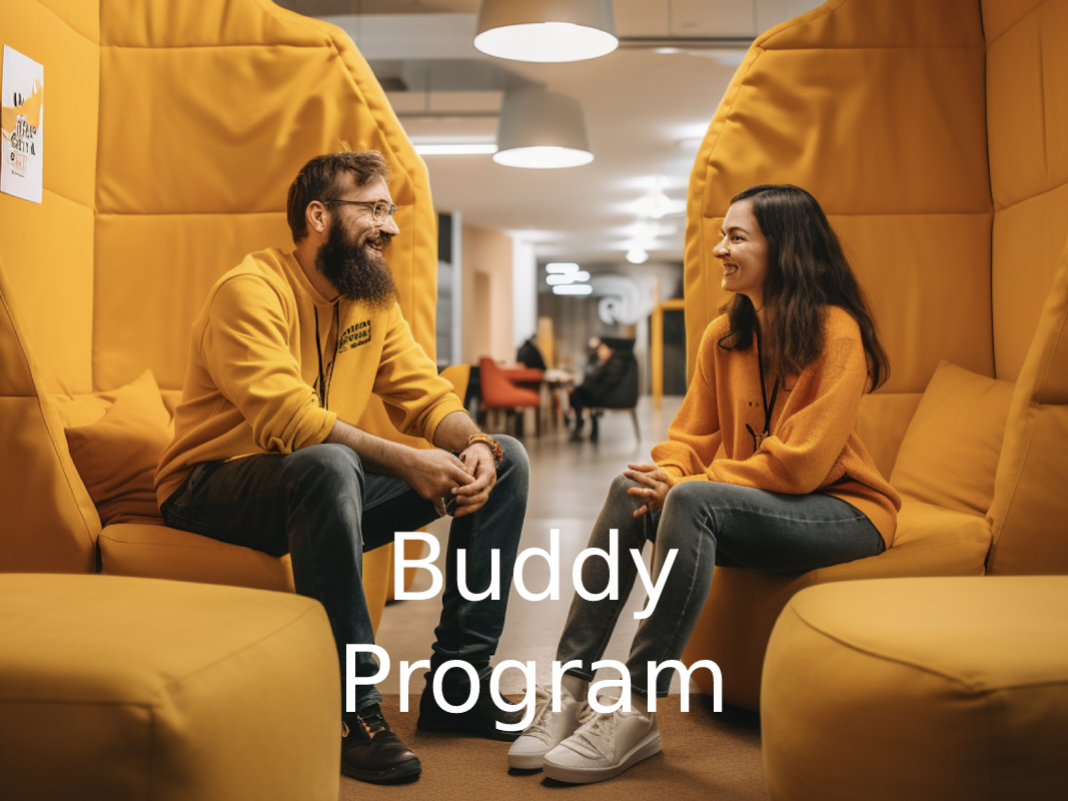
The need
Onboarding junior profiles cannot rely on HR and the direct Manager alone: someone joining the company needs a person close at hand to understand the context and its culture, and also to ask simple questions, in order to feel part of the group and to contribute quickly. Research on organisational socialisation has long pointed to relationships with colleagues as one of the factors that most help new hires settle in.
For this reason the Company chose to entrust the buddy role to its own young talents, who accompany a new hire from another Division for a few months.
But to be an effective guide for new hires, it takes the ability to communicate, to read how the other person is experiencing their new role, to sustain their motivation and to run useful periodic conversations, which in turn feed HR's work.
For HR the question becomes: how do you prepare a buddy so that the role is carried out well and consistently by everyone, and is also an opportunity to grow for the person filling it?
How we worked
- A defined role. The buddy is a colleague who accompanies the new hire, supports them in keeping motivation and engagement high, and makes it easier to build relationships with new contacts. The buddy is prepared and involved in the induction process, offers practical support (processes, procedures, spaces, network), passes on company values and culture and meets the person every month.
- Simple, shared rules. The buddy knows and oversees a clear process made of meetings with the new hire and their manager. Monthly conversations close with a report in a shared format for HR and the manager. After the first conversation there is a follow-up meeting with HR, and a short internal training session clarifies the administrative aspects.
- A workshop on communication, relationships and motivation. In this workshop, aspiring buddies are trained in a highly tailored way. They recognise their own style and those of others through concrete, practical tools, they learn to read the other person's perspective with empathy and to adapt pace, information and approach. They explore what moves people through motivational models and tools that are effective yet simple to apply.
- One-to-one activities. Individual sessions to help new buddies make sense of their first experiences in the real relationship with the new hire.
The buddy role carries no hierarchical authority: that is precisely what makes it a valuable chance to practise managerial behaviours — listening, motivating, giving feedback — without the distortion that comes with being the boss.
The results
- New hires find a point of reference who helps them feel at ease with the organisation sooner and reduces the confusion of the first days.
- Simple practical questions get answered promptly and without bureaucracy, and the other orientation activities connect to real work.
- Young talents develop skills in communication, motivation and running conversations, and contribute first-hand to settling in new colleagues.
- HR and managers follow how each new hire is progressing through the monthly reports and can offer the right support at the right time.