

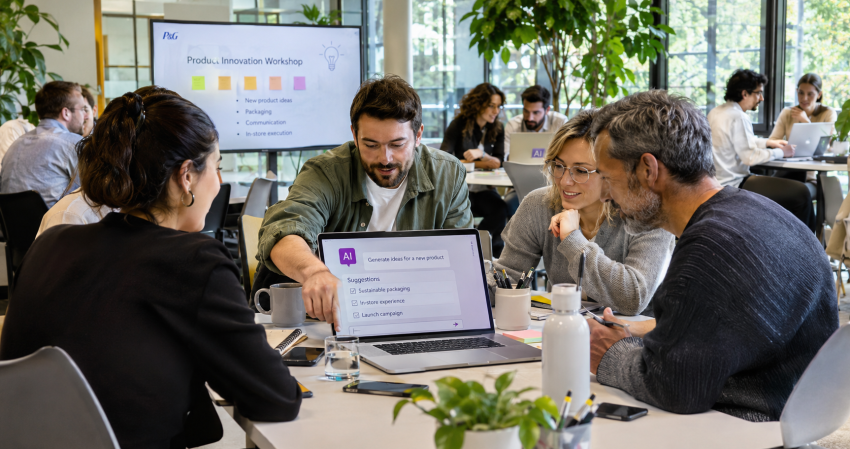
A person working with generative AI produces solutions of a quality comparable to that of a pair of colleagues without AI. This is shown by field research at Procter & Gamble on real business problems.
The problem: decisions about AI are made without evidence on teamwork
Wherever people can work supported by AI tools, their performance is the result of a hybrid Human-AI system. The study’s authors asked how introducing AI affects the three benefits usually attributed to teamwork.
- Performance: teams solve more complex problems.
- Skills: the team brings together different kinds of knowledge.
- Social dimension: working with others brings pleasure and motivation.
These are issues HR deals with every day: quality of work, access to skills, the experience of the people who do the work. The study is titled The Cybernetic Teammate, June 2026.
The study: a real working day at Procter & Gamble
The context
The study was carried out at Procter & Gamble, with more than 700 professionals from the Commercial and R&D functions. It was developed over the course of a year together with company management, to reproduce real product-development routines. Managers reported coordination frictions and cultural differences between the two functions and wanted to understand whether AI could ease them.
The task was a one-day virtual workshop on real business challenges from their respective units: new products, packaging, communication, in-store execution. The incentives were concrete, because the best proposals would be presented to the business-unit leaders, and the best ideas entered the innovation pipeline. Each individual or team generated five ideas, chose one and developed it into a single detailed solution. The solutions were evaluated by business and technology experts who knew neither the condition nor the profile of those who produced them, with on average more than three independent evaluations per solution.
| Condition | How the work is done | Label in the study |
|---|---|---|
| Individual without AI | A person alone, without AI (control group) | Individual No AI |
| Team without AI | R&D + commercial pair, without AI | Team No AI (T1) |
| Individual with AI | A person alone, with AI | Individual+AI (T2) |
| Team with AI | R&D + commercial pair, with AI | Team+AI (T3) |
Results: quality, skills, choice of ideas
A person with AI reaches the level of a team
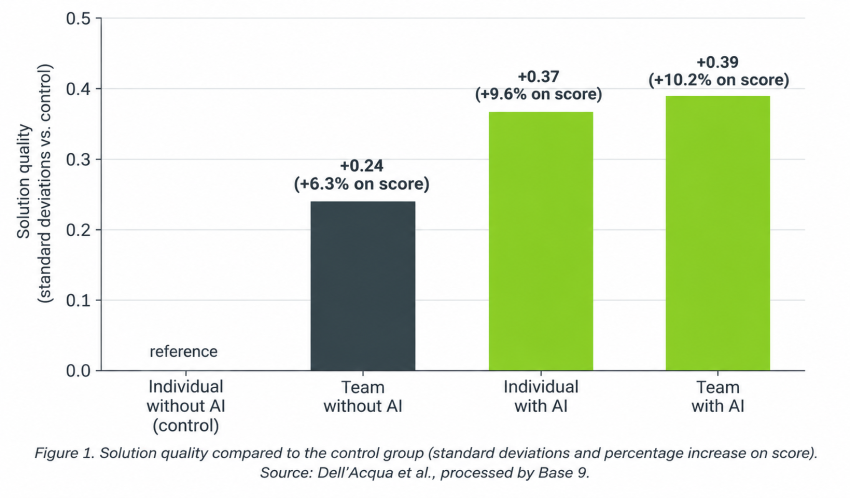
Quality was measured with a score from 1 to 10 and standardised against the control group, so it is read in standard deviations.
The team without AI beats the individual without AI (+0.24, p < 0.05), confirming that teams really do produce better results.
The key figure is another one: the individual with AI achieves +0.37 (p < 0.01), a level comparable to that of the team without AI.
The team with AI reaches +0.39 (p < 0.01).
Skills and the boundaries between functions
People who do not have product development as their main activity achieve modest results on their own and without AI, and even in a team they improve little. With AI, these people reach levels comparable to those of teams that include at least one expert. AI partly replaces the guidance that usually comes from more experienced colleagues.
Without AI, everyone proposes ideas in line with their own background: R&D more technical solutions, commercial people more market-oriented ones. With AI the difference almost disappears, both groups generate a more balanced mix and quality does not worsen. In teams, without AI the solutions split into two groups, technical and commercial, probably depending on the more influential member of the pair. With AI the distribution is more uniform, a sign of less dominance by a single perspective.
Emotions: AI changes how people feel at work
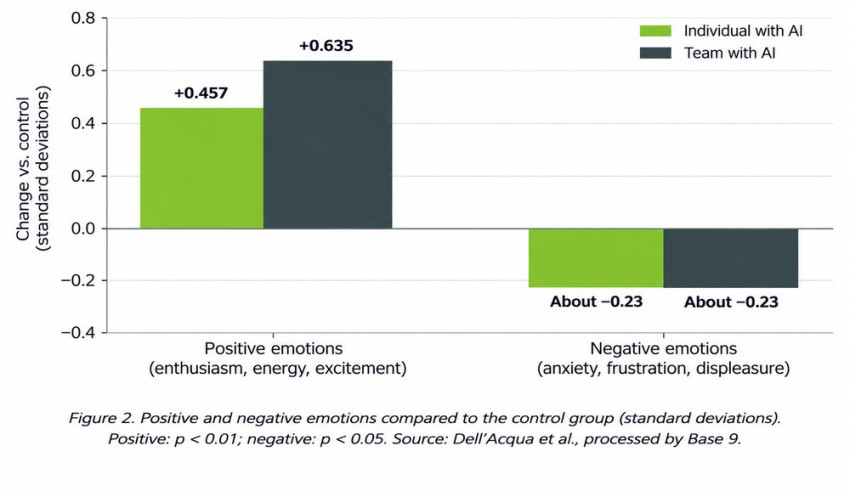
The third benefit of teamwork is the social one, and here the study delivers perhaps its most unexpected result. Before and after the task, participants rated their positive emotions (enthusiasm, energy, excitement) and negative ones (anxiety, frustration, discomfort). The chart shows the change relative to the control group.
Both the individual and the team using AI report more intense positive emotions and less intense negative emotions.
Without AI, those who work alone feel weaker positive emotions than those who work in a team. With AI, the individual reaches or exceeds the emotional levels of those who work in a team without AI.
The authors conclude that AI can replace part of the emotional benefit of teamwork.
For HR this has practical weight: AI enters the scope of the work experience and not only that of productivity.
More quality ideas, but weaker selection
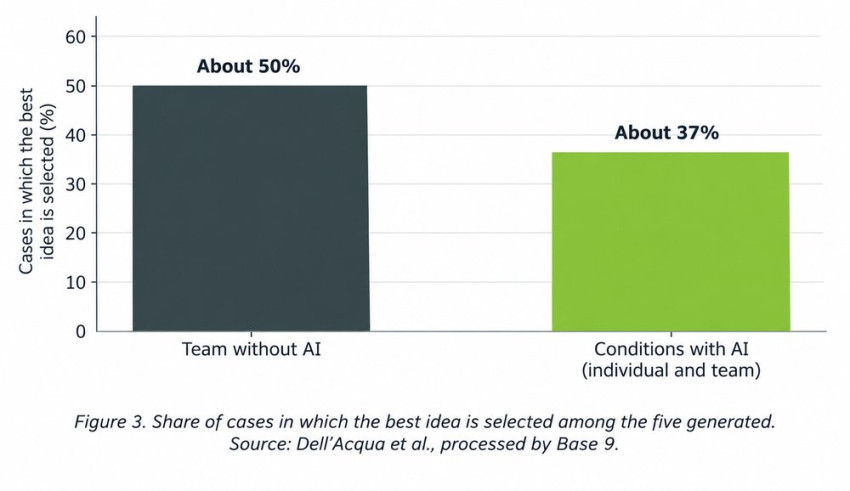
Breaking down the process, AI raises the average quality of the five initial ideas in both AI conditions. The range between the best and the worst idea stays similar, so the entire distribution rises without flattening. On selection the picture is different.
Teams without AI pick their own best idea about one time in two. With AI the share drops to around 37%. The selected idea is still on average of higher quality, because the upstream improvement offsets the selection error.
The authors propose three explanations: the tendency of language models to please the user, the lower friction compared with a human colleague who disagrees, and weaker personal involvement with ideas developed together with AI. It should also be considered that many participants may not have used AI to choose. AI amplifies the quality of the starting material, while the choice of which idea to develop remains an area where human judgement retains a specific value.
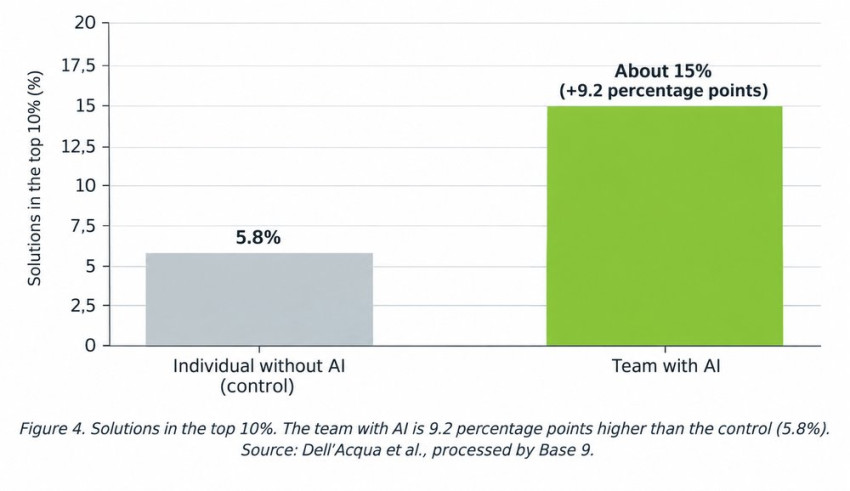
Exceptional results
For leading innovations, what matters is the high tail of the distribution, that is the top 10% of the solutions generated.
The team with AI has a 9.2 percentage-point higher probability of ending up among the best solutions than the control, which starts at 5.8%. For the individual with AI the effect is positive but not significant. AI and human collaboration together therefore seem particularly useful for exceptional results.
Beyond simple AI Adoption
An AI adoption plan often rests on three tools:
- a course on tools and prompting that is the same for everyone;
- pilots in individual departments evaluated with satisfaction questionnaires;
- a list of AI skills valid for the entire company population.
These are reasonable steps. The study’s data, however, show three points they do not cover.
- The same tool is used in very different ways. Only 38% of participants used the suggested prompts, with no performance difference compared with those who did not. In many cases over 75% of the sentences in the final solution came from AI, while a non-negligible share of participants kept none of it, using AI to brainstorm or to validate their own ideas. A course on prompting does not tell you how a collaborator will behave on the job.
- Self-perception does not match the result. Participants with AI produced objectively higher-quality solutions, but expected less often to place in the top 10% (9.2 percentage points less). A self-assessment or satisfaction questionnaire measures an experience, not a performance.
- The effect of AI depends on who uses it. Those starting with less experience on the topic gain a lot, R&D and commercial converge towards the same mix of ideas, and the choice of the best idea worsens. A one-size-fits-all list of skills does not capture these differences. We argue that competence requirements depend on each person’s role, space of autonomy and scope of responsibility, and must be assessed in a work context that includes AI.
What we do at Base 9
These are three very important pieces of evidence when thinking about professional contexts where performance is generated by Human-AI collaboration. To decide how to introduce AI, how to design the new workflows and the related training, and how to compose teams and roles, you need to observe how people work with AI, and not merely ask them.
Starting from premises similar to this study, since 2024 at Base 9 we have built the proprietary platform AI Based Challenge© which, through 8 metrics, detects how people interact with AI and integrate it into the assigned task. We have derived observed-behaviour evidence attributable to 4 different approaches regarding:
- the way people develop awareness and knowledge of the task and the context;
- effectiveness in finding and generating content and information;
- cognitive style in collaborating with AI.
These different approaches underlie the performance people express when using AI and are important for redesigning workflows and directing training in AI Adoption processes.
If you would like to explore how Human-AI collaboration affects Performance and Talent Management processes, get in touch.
Source: Dell’Acqua F., Ayoubi C., Lifshitz H., Sadun R., Mollick E., Mollick L., Han Y., Goldman J., Nair H., Taub S., Lakhani K.R., The Cybernetic Teammate: A Field Experiment on Generative AI and Teamwork. Organization Science. DOI: 10.1287/orsc.2025.20702