

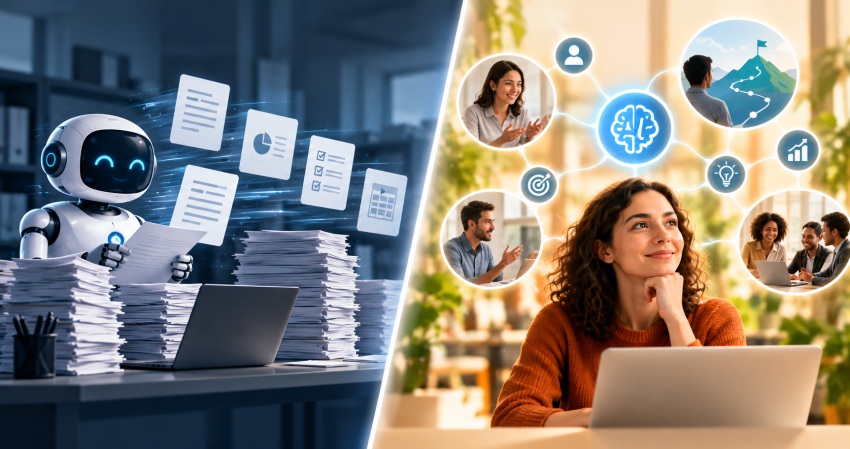
The real transformation of L&D is not about creating courses faster, but about redesigning learning with the individual at the center.
Introduction: Beyond the efficiency trap
Over the past two years, the arrival of Generative AI in HR departments and Corporate Academies has mostly translated into one operational question: “How can we do the same things in less time?” Generating presentations in seconds, summarizing handouts, creating quizzes and automating course management are useful achievements. But are they enough to speak of real innovation?
The answer is no. There is a profound difference between applying AI to increase the delivery efficiency of those who manage training and using AI to rethink the entire corporate learning system.
If you stop at the first dimension, you merely automate traditional processes. To make a real leap in quality, you need an innovative mindset capable of putting the individual at the center and, at the same time, the technical expertise to design a completely new learning architecture.
1. The Delivery Efficiency trap: doing the old things faster
In the first scenario — delivery efficiency — AI is used as a tactical productivity tool for trainers and instructional designers:
- Automating the drafting of texts and learning materials.
- Quickly generating assessment questions or satisfaction surveys.
- Cutting the time needed for transcription, summarization and translation of content.
The gains in time and operational efficiency are undeniable. However, the end experience for employees stays the same: the underlying pedagogical model remains standardized, transmissive and based on the passive consumption of content. The work of those who deliver training gets faster, but the real impact on skills and on behaviors in the company is not transformed.
2. Systemic Innovation: rethinking person-centered Learning
In the second scenario, AI becomes the enabler of a deep rethinking of the learning architecture. Technology is not there to “replace” the classroom or to produce more slides, but to free up space for what makes learning truly effective: personalization, guided practice, human interaction and critical thinking.
Rethinking the learning system means acting on three key directions:
- Hyper-Personalized Learning (in the flow of work): AI works behind the scenes to analyze individual gaps and suggest tailored micro-paths for each employee, embedding training into daily work (as shown by the advanced ecosystems of Siemens My Learning World).
- Protected environments for simulation and experiential practice: Using AI-based conversational simulators to let employees practice complex conversations (e.g. customer handling, negotiation or feedback), with immediate feedback in a safe context before facing real situations (an approach adopted by Bank of America – The Academy).
- Evolution of the human role towards Guidance and Mentoring: When technology handles knowledge alignment and gap-filling, trainers and leaders evolve from mere “knowledge providers” into coaches, facilitators and socio-emotional guides. This is the logic of the most advanced educational models (from high-tech schools such as Alpha Chicago to the dual-track programs of large companies), where AI personalizes content and humans develop motivation, leadership, resilience and values.
3. The twofold challenge for HR: a Humanistic Mindset and Technological Literacy
To lead this paradigm shift, the HR function and L&D leadership must develop a twofold, integrated competence:
A. A Humanistic Mindset centered on the Person
As AI automates information retrieval and basic answers, the value of distinctly human capabilities — critical judgment, contextualization, empathy and ethics — grows exponentially. HR should not design mere courses, but development experiences and human–machine collaboration, making sure that technology amplifies individual potential.
B. Technological Literacy and Architectural Vision
Hoping for change is not enough: you need to know how to design it. L&D leaders must acquire clear technological literacy to understand how predictive and generative systems work, define data integration rules and organize a modern, fluid and secure learning ecosystem.
?? Key Question for HR Leaders
“Are we using AI to speed up the old way of training, or to build a new system where people learn better, with more autonomy and more human support?”
Conclusion & Check-up for your Corporate Academy
Artificial Intelligence does not mark the end of corporate training, but its strategic redefinition. To assess where your organization stands, try reflecting on this quick check-up:
- Is AI used only by trainers to produce materials faster? (Operational Efficiency Level)
- Do employees have access to adaptive learning paths and protected spaces to simulate and practice skills? (Personalization and Experience Level)
- Have internal teachers and managers been empowered in the role of coaches and change facilitators? (Systemic Transformation Level)
Those who can combine humanistic sensitivity with technological vision will turn Corporate Learning into the true strategic engine of business innovation.