

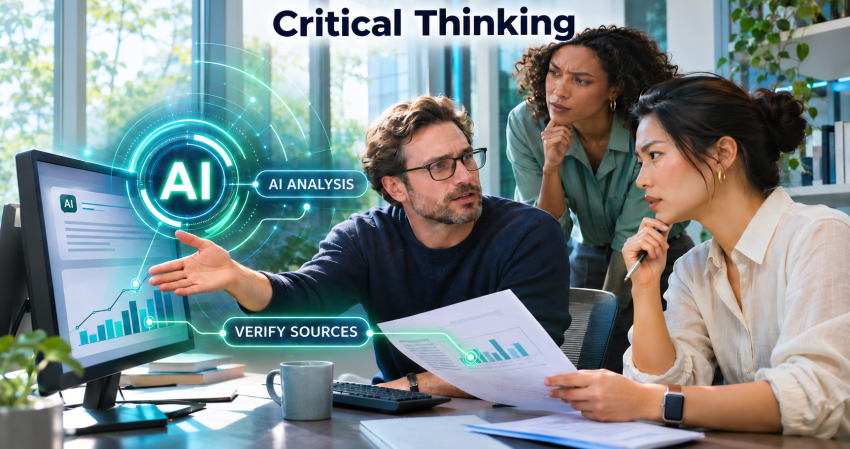
For two years we have been told that generative AI will make critical thinking more and more necessary. The statement is correct, if very generic. It stems mainly from observing personal use of AI, where the fear is mental laziness: people take the first answer and never check it.
When Artificial Intelligence becomes a tool used in professional settings, things change. Whoever analyzes financial data, reviews code or writes a commercial proposal is accountable for the result. There are quality standards, deadlines, clients and consequences to answer for.
To understand what really happens in a professional context, the most solid source available today is the Microsoft Research study "The Impact of Generative AI on Critical Thinking: Self-Reported Reductions in Cognitive Effort and Confidence Effects From a Survey of Knowledge Workers" (Lee et al., ACM CHI 2025). The researchers collected 936 real-world cases of AI use by 319 knowledge workers across different sectors, asking them when and how they exercise critical thinking.
One limitation should be stated: the data are self-reported, meaning they capture people's perceptions. This is precisely why it is useful to compare them with behavioral data, as we will see later.
What the study shows
The study reveals a more complex picture than a simple need for critical thinking when using AI. Other factors come into play: the phases in which cognitive effort is greatest, trust in AI and in one's own skills, and thinking capabilities that cannot be reduced to critical thinking alone.
1. Cognitive effort changes place
AI sharply reduces cognitive effort in the phases of retrieving information and producing a first draft of work that must integrate AI output. It increases it, instead, in the phases of evaluation and adaptation to context.
In complex tasks, or where an error has critical consequences (for the business or for the person doing the work), people invest far more critical thinking than in routine tasks.
2. Trust matters, and in two opposite directions
The study's quantitative analyses show two effects:
- Trust in AI: it is inversely proportional to critical thinking. The more a worker trusts AI's ability to perform a given task, the less they check. Passive reliance (overreliance) is also more frequent precisely in tasks that seem simple.
- Confidence in one's own skills and in one's own ability to evaluate the output: these are directly proportional to critical thinking. Those who know their trade well use AI to test their own judgment and accept the extra effort of verifying the answers of Artificial Intelligence. The result is a more reflective approach, in which one's own competence in steering the use of AI is central.
3. Critical thinking changes nature
According to the authors, AI does not eliminate traditional cognitive activities but transforms them:
- From searching for and gathering information, to verifying sources
- From solving the problem directly, to integrating the output provided by AI
- From executing the task, to stewarding the process of getting the work done
What organizations need: the Base 9 perspective
The study tells us where critical thinking is shifting. The crucial question, from the standpoint of those who work in People Development, remains: how is it developed, and how can it be recognized in people who work with AI today?
On this we have a base of direct observation. With AI Based Challenge©, through 8 metrics, we measure how people use AI while tackling professional activities. The analysis is not based on what people declare, but on their real interactions with AI. From observing about 300 professionals engaged in professional activities, three dimensions emerge that characterize, in different ways, how AI is used for work:
- how much people explore,
- how efficiently they work,
- how they steer AI.
These modes of use can be traced back to what the Microsoft study identifies as verification, integration and stewardship of the process.
Starting from the research and integrating our field experience, we draw four clear indications for implementing and adopting AI in the company.
1. Map the uses before training. Among the people observed we identified four recurring profiles of use. They are approaches to using AI at work, each with different strengths and risks. A one-size-fits-all training path serves no one.
2. Train the four competencies together. Prompt engineering alone is not enough. What is needed:
- Critical thinking: evaluating the accuracy, relevance and logical soundness of what AI produces.
- Systems thinking: understanding how the outputs of my AI-supported work affect processes, relationships between departments, the quality of information and the long-term resilience of internal skills.
- Dialogic and strategic thinking: steering AI through iterations that follow structured reasoning, using it as an interlocutor that proposes alternatives and challenges ideas.
- Decision making and accountability: knowing when, where and how to apply, adapt or discard AI's contribution, while remaining owners of the result.
3. Measure behavior. If trust in AI reduces checking, as the study shows, self-assessment alone is not enough to tell who really checks. Observing how people interact with AI in realistic situations provides crucial data that no questionnaire can deliver.
4. Identify ambassadors based on behavior. Those who explore and, at the same time, steer AI with method are the natural candidates to spread good practices within teams. They are recognized by how they work, not by their role or declared enthusiasm.
In summary, for those who lead people
The risk for an organization is to lose, without noticing, the skills needed to judge what AI produces. The Microsoft study shows that domain expertise and confidence in evaluating are what keep critical thinking active.
Our work with AI Based Challenge© adds that the ways of using AI differ and can be measured, and that they show strong correspondences with the research findings.
From here begins a training approach built on the real people of a company.
Frequently asked questions
According to the Microsoft Research study presented at CHI 2025 (319 knowledge workers, 936 real-world cases), AI reduces effort in retrieving information and producing a first draft, and increases it in evaluating outputs and adapting them to context. Workers who trust AI heavily on a task tend to check less. Those who trust their own skills and their ability to evaluate tend to check more. The data are self-reported.
Prompt engineering alone is not enough. Four skills should be developed together: critical thinking, to assess the accuracy and soundness of outputs; systems thinking, to understand the impact on processes and internal skills; dialogic and strategic thinking, to steer AI with structured reasoning; decision making and accountability, to decide what to accept, adapt or discard while remaining owner of the result.
Questionnaires are not enough, because trust in AI can reduce checking without people noticing. Base 9 uses AI Based Challenge©, which observes real interactions with AI during simulated professional activities, through 8 metrics. Observing about 300 professionals revealed three dimensions: how much people explore, how efficiently they work, how they steer AI. These are the basis for mapping uses, designing targeted training and identifying ambassadors.