

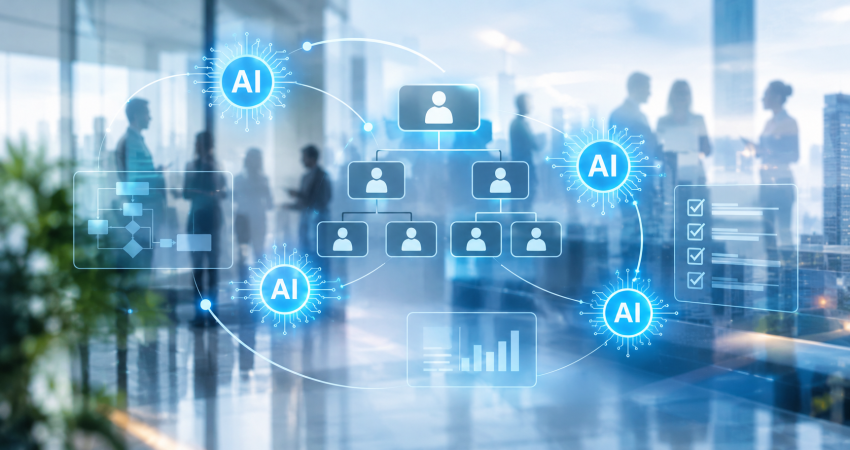
AI also changes what organizations are for. For a century, organization design had a precise job: to make market complexity governable by creating a predictable flow of demand to assign to functions, roles and hierarchical levels.
Today, a single professional with a well-built system of agents can run a function or an entire process, and complexity stops being something to contain through structure. It becomes data that the system processes in real time.
The most recent studies show what is changing in organizational structures, in managers' work and in the workload of those who supervise. They also show that complexity moves; it does not disappear.
Organizational transformation with AI
It is not enough to ask which tasks will be delegated to AI and agents. The questions are how many layers are still needed, who decides what, what it means to manage people when part of the work is done by agents, and what skills are required of those who supervise them. These are organization design questions, and they fall to HR, because they concern roles, careers, selection and development.
Organizational models have evolved several times, from functional structures to processes, from customer-centric to agile organizations. The way of working changed; the premise stayed the same: external complexity is a problem the organization must absorb with ever more adaptable processes and skills. People process information, layers filter and pass it on, roles share the load. Organizational structure and its hierarchy are the classic answer to a specific limit, the human capacity to process information, which Herbert Simon called bounded rationality.
The most common response to AI follows the same logic. The tool is inserted into existing processes, job descriptions are updated, training on usage is organized. These are useful steps, but they leave the design intact: same layers, same approval circuits, one more assistant. This optimizes the existing response, but it does not unlock the full potential of AI.
The signal comes from fieldwork. In the pre-registered experiment with 791 Procter & Gamble professionals, a single professional with AI matched the performance of a team without AI and crossed the boundaries of functional silos (Dell'Acqua, Lakhani, Mollick et al., Organization Science 2026). If the augmented individual does the work that used to require a team, then the team, the layer that coordinates it and the role that oversees it need to be rethought.
Fewer layers, less middle management: what studies and cases say
The evidence converges on one direction: with AI, organizations tend to lose layers and middle managers see their coordination function shrink (MIT Sloan Management Review and BCG, November 2025). Each study and case has its own specifics. This flattening is a direction, firmly grounded in how work is being transformed by AI, but it must take many factors into account.
Kim and Koning (Kim (INSEAD) and Koning (HBS), "AI-Native Firms", 2026) found that AI-native startups have 25% fewer people, 15% fewer managers and a hierarchy half a level flatter, at equal valuation. Headcount reduction comes mainly from AI embedded in the product and less from AI used as a work tool, so an innovation component is also at play.
Several company cases show that the move toward flatter organizations is already under way. At Amazon, Andy Jassy has asked for leaner teams and fewer layers and, as reported, an increase of at least 15% in the ratio of individual contributors to managers (Armory Square).
The most useful point for HR is that flattening does not necessarily mean decentralizing. As INSEAD has observed, AI-based monitoring and decision tools allow a few managers to control many people: the org chart flattens while authority can remain concentrated.
What these studies and cases show is that the function being reduced is the transmission and control of information. The function of orienting, developing and holding people accountable remains, and weighs more heavily on fewer people.
From prediction to purpose: how managerial work changes
The research "Purpose not prediction" by Amir Goldberg (Stanford) and Phanish Puranam (INSEAD), an editorial in the special issue on AI of the Journal of Organization Design, starts from an observation: much of managerial work, such as planning, budgeting and monitoring, consists of prediction, which is what AI does best.
It would be wrong to conclude that managers will disappear. The authors argue that managers remain necessary as long as the capacity and the right to define higher-level goals remain distinct from those of AI. Replacing them would require minimum thresholds of both technical performance and normative acceptability. In an interview, Goldberg added that a machine's priorities are for now set by its designers, and setting and evaluating goals remains a task for people.
Clear and useful indications come from the recent BCG study of more than 50 companies pioneering the use of AI to reinvent how work is done. Five discontinuities emerge:
• teams are accountable for outcomes rather than executing tasks;
• machines produce while people direct and evaluate;
• decisions move down to those closest to the problem;
• coordination changes;
• pay rewards impact.
In the study, BCG describes work organized around systems of agents that coordinate dynamically: leaders set the objectives and networks of agents decide how to achieve them (BCG, April 2026).
An interesting finding comes from the work of Reitzig and Heiss (MIT SMR, 2025), who show that when a company removes layers, the composition of its workforce changes: the share of people who thrive in autonomous conditions grows. Organization design therefore also acts on who stays and who is selected, which is a matter of selection and assessment before it is a matter of org charts.
In the Work Trend Index 2025, Microsoft introduces what it calls the capacity gap. 80% of the global workforce say they lack the time or energy to do their work, and on average an employee is interrupted by a meeting, email or message roughly every two minutes. Demand for work exceeds human capacity, and agents are proposed as the lever to close the gap. The most interesting novelty for HR is a new metric, the human-agent ratio, the ratio of people to agents, to be used for workforce planning. Microsoft specifies that the ratio varies from task to task and invites organizations to ask how many agents are needed for which roles and how many people to lead them. Among its criteria are cases where people and digital labor together beat AI alone, cases where customers prefer human contact and cases where someone must answer for the outcome, as in high-risk product or financial decisions.
Moderna merged HR and IT into a single function led by a Chief People and Digital Technology Officer, who decides what people do and what technology does, and uses more than 3,000 specialized GPTs.
BNY has created "digital employees", agents with credentials, an employee ID and a human manager, about 140 of them, while more than half of employees build agents. A dedicated internal structure decides whether an activity goes to a person, an external contributor or an agent: this is the human-agent ratio managed as a corporate function.
Complexity does not disappear: it moves
The complexity that used to be spread across many people and many layers has to go somewhere. Studies point to four destinations.
1. System architecture. With agents, integration cost no longer grows with the square of the number of components but linearly, while verification grows with the volume of tasks performed. The resulting enterprise separates execution from central management and coordinates it with protocols and controls instead of hierarchical supervision. The complexity lies in designing those protocols and controls, which someone must design, maintain and correct.
2. Governance. If agents decide how to reach objectives, it must be established who is accountable for what. The opposite risk is the one flagged earlier: fewer layers without explicit governance concentrate control and decisions at the top and give rise to informal power.
3. Ecosystem dependency. Complexity has not vanished: it has moved from inside the organization, where agents operate, to the contracts, suppliers and platforms on which the organization depends.
4. Cognitive workload. AI intensifies work instead of reducing it: faster pace, a wider scope of tasks, work spilling into breaks. A BCG study published in HBR in March 2026 of 1,488 workers ("AI brain fry") indicates that supervising agents is the most tiring activity and that beyond three AI tools perceived productivity drops; using AI to eliminate repetitive tasks, by contrast, reduces burnout by 15%.
The constraint to design for: purpose, judgment, verification, accountability
If hierarchy arose to work around the human limit in processing information, and AI pushes that limit much further out, organization design must ask what only a person can and must do.
From the research and cases we analyzed, four human capabilities appear to be the ones to focus on:
• Setting purpose. Defining the goals worth pursuing remains the ground that distinguishes managers from AI.
• Judging. Deciding when an agent, a person, or the two together are the right choice is a judgment about the work, not a calculation.
• Verifying. The cost of verification grows with the volume of tasks done by agents, and supervision is the most tiring activity.
• Being accountable for results. With agents executing, someone must remain the name and face behind a decision.
In short, organization design used to reduce and channel external complexity through structure, roles and hierarchies.
With AI, it becomes the design of the architecture in which people and agents treat complexity as an operational input in real time.
The constraint to take into account in organization design is no longer the human capacity to process information, but the human capacity to set purpose, exercise judgment, verify and be accountable for results.
What HR can do and how Base 9 works
For HR, the shift from designing structure to designing purpose translates into four concrete moves.
1. Check, for every activity at every level, what needs to be decided. For each layer, ask what it decides that no other layer can decide. Where the answer is "forward and control", that is the function AI absorbs first.
2. Define the human-agent ratio for each process, and who is accountable. Each process needs a perimeter for agents, a point where a person verifies, and a named owner of the outcome.
3. Assess people on the capabilities that become the constraint. Setting purpose, judging, verifying and taking accountability are competencies observable in context, not generic traits. They are assessed by having people work on real cases with AI available, because the same competency varies with the role's space for autonomy and perimeter of responsibility.
4. Manage the workload of those who supervise. If supervising agents is the most tiring activity, workload, number of tools and work boundaries must be measured, and managers developed to handle them.
On this, Base 9 supports HR functions with potential assessments that observe how people interact with AI and integrate it into their work, with AI training for managers and professionals, and with development paths built on each person's role and perimeter of responsibility. If you want to understand how these capabilities show up in your organization, contact us for a conversation.
Frequently asked questions
The evidence points to fewer layers and wider spans of control. The function of transmitting and controlling information shrinks. Orienting, developing and holding people accountable remains an activity that managers must perform. Flatter designs nonetheless keep decision-making responsibility with middle management and the top. What changes in a manager's work with AI? Work built on prediction (planning, budgeting, monitoring) is the most affected by AI. What remains is defining purpose, that is, the goals worth pursuing, together with evaluating results.
It is the metric introduced by Microsoft for workforce planning: how many agents are needed for which tasks and how many people to lead them. It varies from task to task and accounts for where a person must be accountable.
Overload. Studies by Berkeley Haas, BCG and the British Journal of Industrial Relations associate intensive AI use with intensified work, supervision fatigue across a wider scope of activities, and more stress, linked to workload and not to fear of job loss.
Check what each layer decides, define the people-to-agents ratio and who is accountable for each process, assess people on purpose, judgment, verification and accountability, and manage the workload of those who supervise.