

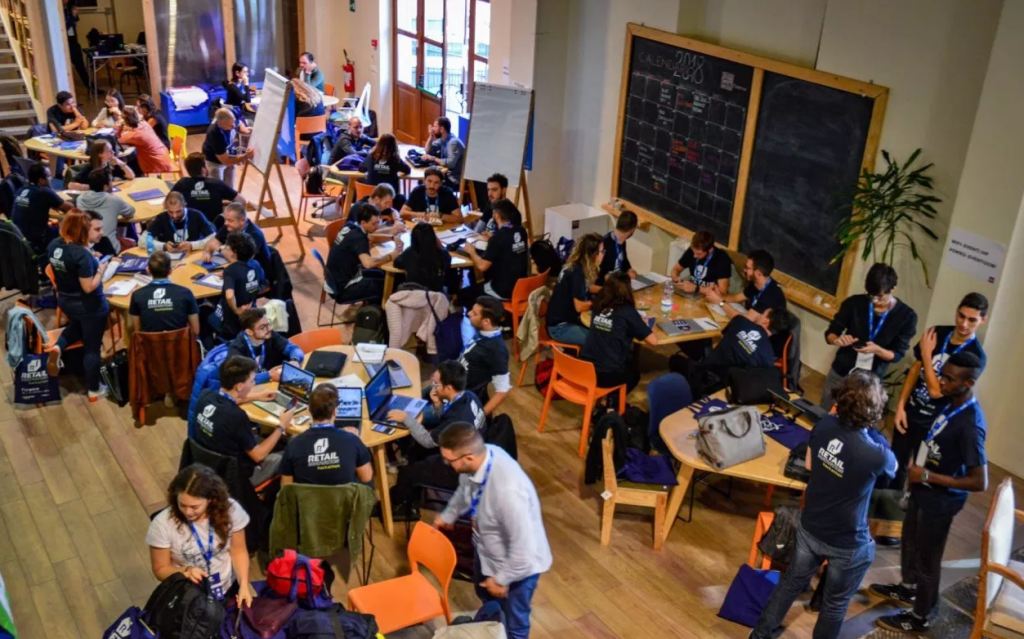
We brought Design Thinking into the idea development process of a Retail-focused Hackathon organized with our friends at Sella Lab for Euronics CDS.
The strength of Hackathons lies in the ability to quickly create innovative solutions in response to a specific challenge. It starts with collecting solution ideas, which are then selected. Around the chosen ideas, small teams are formed and, with the help of experts and mentors, go through the entire process of validating the problem and subsequently developing the solutions.
This is made possible mainly by applying methodologies such as Lean StartUp. The goal of these methodologies is to validate the hypothesized problem or need — does the problem defined by the team actually exist on the market? — and then quickly create a working solution to deliver to the customer for feedback.
But what changes when Design Thinking becomes the methodology guiding participants in giving value to their ideas? What happens when Design Thinking leads the process of turning those ideas into meaningful, human-centered solutions?
Understanding… therefore, ensuring the quality of ideas
The Double Diamond process of Design Thinking in its early stages requires investing in understanding the customer. Not only in terms strictly related to the identified problem/need one aims to address.
In the first “diamond,” the methodology guides us to focus on the customer to immerse ourselves in their context. First, one diverges to observe and understand, then converges to define the space where, within the heterogeneity of the information gathered, one must find meaning and insight that guide the customer's actions and choices. This happens even before clearly defining the problem/need to be solved. The goal is to work on defining the need, rather than starting with an idea/goal to validate.
Despite the typical time pressure of Hackathons, specific guidelines and simple exercises helped people explore the customer's world more broadly and in non-obvious ways.
Imagine taking a step back from a generic idea of a solution to a problem you've already formed when deciding to respond to the hackathon challenge. And thus, starting from a blank page to understand the customer's world. You begin to question what they do, say, think, and feel. Only then do you ask yourself what you can do for them, posing the question “how might we…?”.
Observation and interview techniques, empathic participation, and various other “tools” enable a broader and more complete understanding of the customer.
The result?
In the initial phase of the work, and for at least two hours, fewer computers were seen on the team tables in favor of conversations and flipcharts filled with information, diagrams, and other contributions.
This approach is especially effective when talking about innovation in a Corporate setting. Unlike StartUps, a Corporate can rely on several assets (brand, customer base, experience, products/services, distribution, technologies, etc.). If these assets are not properly viewed from a new perspective, they risk not being fully leveraged—or worse, becoming a constraint on generating truly innovative ideas.
The focus on understanding the customer naturally leads to considering multiple dimensions of the problem/situation in which the customer finds themselves.
This helps avoid the risk of falling in love with a technology-enabled solution, as one develops a personal view of the customer's world and arrives at formulating the famous question “how might we…?”.
The “how might we…?” moment that precedes the work of the second “diamond” is crucial for increasing the intrinsic value of the ideas to be prototyped.
Even during the Hackathon, this question guided the work of the teams, who produced a very broad spectrum of solution hypotheses. They went beyond those that—even unconsciously—are suggested by technological applications and business models perhaps already seen in other contexts.
The final outcome of the proposals also clearly and immediately shows the value of the developed solutions.