

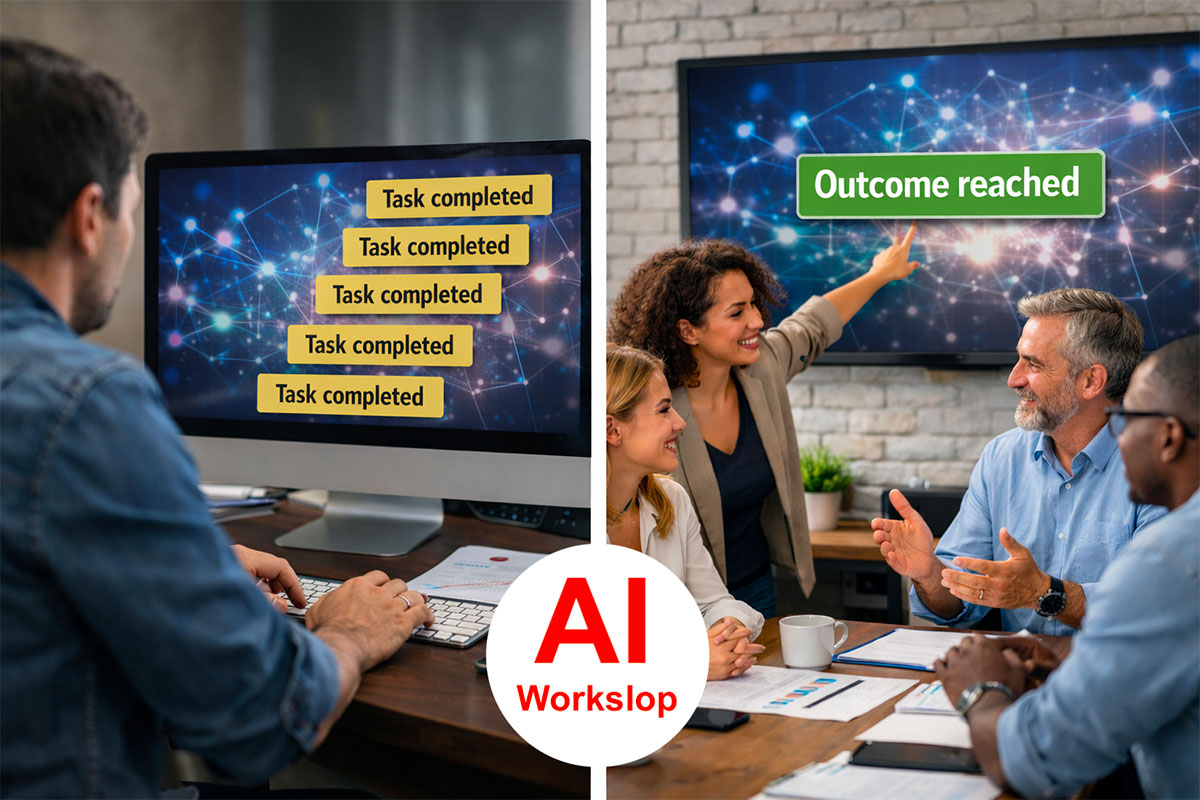
What Is “AI Workslop”?
As Artificial Intelligence becomes more widespread, new terms are also emerging, which are worth knowing in order to name new phenomena.
“AI slop” refers to low-quality, junk content generated with AI that clogs social media.
“AI Workslop” refers to drafts, reports, or documents generated with AI with minimal human effort.
These are materials that at first glance appear well done, but whose review has not been carried out thoroughly by the person who produced them. As a result, the burden of this review falls on the colleagues who receive them, who then have to correct errors and fill in gaps.
The recent article “Why People Create AI ‘Workslop’ and How to Stop It” by Harvard Business Review has shone a spotlight on this worrying phenomenon that is spreading within companies.
There are countless developers who generate AI-assisted code, but integration with the application and the IT ecosystem creates so many bugs that even the manager on duty gives up on putting things in order.
Managers ask ChatGPT to prepare slides and tables based on analyses prepared by their teams, but the output contains errors and proposes inappropriate conclusions.
“AI Workslop” defines that material—reports, emails, presentations—generated quickly with Artificial Intelligence but lacking review, substance, or real usefulness.
Added to this is the phenomenon of the growing use of Artificial Intelligence tools in one’s own work by individuals, driven by the fact that the time freed up by greater efficiency pushes them to use these tools even more.
The result? The person who produces an AI-generated output saves ten minutes, but the person who receives it loses sixty correcting errors or further developing generic content.
Why AI Workslop Reduces Productivity
The research cited by HBR reveals that, without clear guidance, AI risks becoming a “cognitive shortcut” that does not lead to improvements in overall productivity and damages trust among colleagues and professional reputation.
If the opportunity to use AI in one’s work is focused solely on improving delivery speed, the risk is flooding the organization with mediocre content that, paradoxically, requires more human work to fix.
At Base 9 we see this phenomenon happening in real time, but we also have the key to solving it.
Observing AI in Action: the Base 9 Approach
We have observed this phenomenon as well, particularly within projects focused on assessing potential and managing talent in organizations.
During Potential Assessment Centers, through our proprietary platform AI Based Challenge©, candidates and employees face simulated scenarios that integrate the use of Artificial Intelligence.
This has allowed us to obtain concrete evidence of the approach that each person spontaneously adopts in using AI. Through proprietary algorithms, we can detect both Information Retrieval strategies and the strategies through which people tend to guide—or not guide—AI in carrying out professional tasks.
These outputs are always supervised by our consultants, who maintain responsibility and control over the observation process. This is because our goal is to evaluate the entire behavioral process.
What we have observed among more than 350 professionals and managers using Generative AI in simulated contexts is very interesting.
Very different context analysis processes and ways of integrating AI into one’s own work emerge among individuals, translating into truly distinctive performance—or into performance that fuels the phenomenon of AI “Workslop”.
The resulting performance is linked to people’s behavior in using Generative Artificial Intelligence, not to the mere availability of the technology.
From Observation to Transformation: Our Labs
Many companies are investing in training to learn about, understand, and use AI and the new tools that emerge every day, but less is invested in supporting people in expressing their talent in a work environment where AI is widespread.
Identifying the behaviors that characterize each person’s use of AI at work is only the first step. To help people—and therefore companies—derive the maximum competitive advantage from AI, it is necessary to embark on a path of concrete experimentation in a protected environment.
Human–AI interaction also leads to redefining the concept of Talent, not simply by indicating which skills will be central in work environments where AI is widespread.
The new concept of Talent (see our article “AI and Talent Management”) must engage with new and broader spaces of autonomy, with awareness of the purpose it is serving, and with the potential to create more value than in the past.
For this reason, we have developed an experiential program aimed at redefining the way people work using AI. The program is structured in two phases:
1. Awareness and Mindset
Before teaching “how to do it,” we work on the “why.”
Through the data that emerge from our platform when we ask people to work with Generative AI in a simulated context, we help them become aware of their own approach, their strengths, risks, and areas for improvement. We show them the real impact of their way of working with AI on the quality of their work outcomes.
2. Creating Real AI Solutions
Once awareness has been acquired, we move on to the transformation phase. We help people become “architects” and guide AI tools within their professional context, supporting them in the creation of customized AI solutions that are purpose-driven. In this phase, we use content and information similar to what they use every day (sometimes, at the client’s request, we work with real content and information from their own organization).
By directly experimenting with the solutions they have created, people understand the reactions and potential of AI and are able to reread their own work with greater awareness, identifying areas that can be delegated to AI without losing value—indeed, creating new value—because they are able to maintain strategic and qualitative control over their work.
In Summary
Artificial Intelligence should not be a machine for producing “slop” (waste), but an amplifier of human talent. The secret lies not in the tool, but in how people choose to inhabit it.
At Base 9, we help organizations transform the use of AI from a potential waste of time into a value engine in talent management within companies and the development of their potential.