

What is design thinking
In a world where innovation has become an increasingly pervasive expectation across every business sector and organization, Design Thinking can represent an effective response.
Design Thinking is a methodology for creating innovative solutions and solving complex problems.
This approach was formalized around the 2000s in California by Stanford University.
It is also known as the *human-centered design* method, as it focuses on people and is based on the ability to combine analytical skills with creative attitudes to understand users’ or customers’ needs — even the hidden or unconscious ones.
Applying it requires not only mastering and managing the method but also adopting the right mindset and perspective.
Overcoming Complex Challenges
The Design Thinking framework begins with the so-called “problem/challenge statement.” This refers to the Double Diamond model developed by IDEO, a design company closely associated with Stanford University’s d.School.
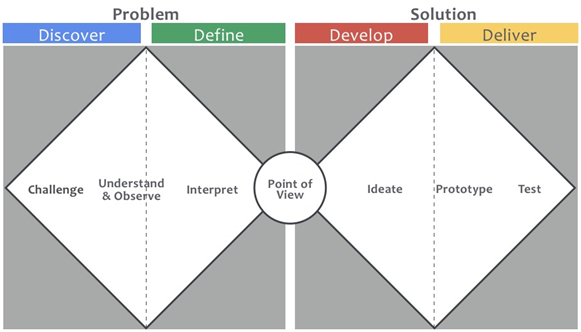
- UNDERSTAND: in this phase, the team diverges to understand the challenge/problem, the people/users, the technology and constraints, other stakeholders, and existing solutions.
- OBSERVE: this is a qualitative and divergent phase in which real people are observed in real situations. Empathy is a key differentiator of Design Thinking compared to other methodologies. The goal is to deeply understand what people say, feel, think, and do. This may include research, data, and insights from other sources, and everything is documented — often visually.
- INTERPRET: this is a converging phase where all gathered insights and elements are synthesized to form the outcome of the problem analysis phase. It helps identify patterns, areas of action, recurring elements, triggers of behavior, and desired pain points or benefits.
- POINT OF VIEW STATEMENT: this is the transition between the first and second Diamond, delivering to the next phases a unique and fresh perspective on the challenge — one that was generated through a human-centered process. In the second Diamond, this point of view becomes the starting point for ideating and building the solution.
- IDEATE: this is a divergent phase where the goal is to generate as many ideas as possible with all team members, using techniques like brainstorming, benchmarking, and visual methods.
- PROTOTYPE: in this phase, the team converges again, defining a possible solution and building its prototype. The goal is to make the idea tangible as soon as possible. The prototype can be made from any material or digitally — what matters is that users/clients can interact with the functions that bring the idea to life.
- TEST: testing aims to gather qualitative feedback from users/clients interacting with the prototype. As we’ll see in the next module on prototyping, there are many ways to build a prototype. What’s important here is that tests can yield many new ideas to further improve and develop the solution.
The Challenges for HR
What are the current challenges for HR? And how can Design Thinking offer a different response from the ones companies are currently implementing?
According to the Deloitte Global Human Capital Trends 2019 survey, the 5 priority areas where HR is expected to innovate its value proposition are:
- Learning, which has become urgent in identifying new skills to be acquired quickly, providing adequate tools, and finding new ways — including opening up to external partnerships with universities, research centers, and even competitors.
- Leadership development, with the priority of renewing the mindset of C-levels to enable more agile ways of working, breaking down silos, and creating a new culture focused on delivering value to employees and customers.
- Talent mobility, where HR will need to innovate career paths with a more horizontal, personalized approach that connects individual purpose with corporate purpose — positively impacting employee engagement.
- HR technology, where I believe we need a qualitative leap in designing a human-centred work environment that enhances people’s potential. This means not just investing in advanced technologies like AI applied to existing processes to boost efficiency, but rethinking those processes altogether.
- Employee experience, which I see as the true priority encompassing all of the above — and the area where HR can invest to deliver distinctive value to the business. Yet, while 75% recognize its importance, only 46% say they are ready to take concrete action.
Even acknowledging a certain level of simplification — inevitable due to space constraints — we can say that many HR departments are tackling these challenges with a “remedial” mindset aimed at reducing gaps.
We shouldn’t be surprised or scandalized by this. HR has always been expected to address problems related to people. And responses have traditionally been shaped by rigorously applying the latest People Management methodologies and practices, using a linear problem-solving approach. For example:
- Low employee engagement? HR launches engagement projects — but the solutions are often standardized.
- Digital transformation? HR’s task is to close the digital skills gap — but transversal skills required for new ways of working beyond silos are often overlooked.
- Struggling to attract talent? HR invests in storytelling and employee training to turn them into brand ambassadors.
Design Thinking allows HR to move away from a classic problem-solving approach that values strict adherence to disciplines, processes, and People Management tools — and instead focus on designing and implementing innovative, human-centred solutions.
This makes Design Thinking a fundamental skill for the HR professionals of tomorrow, enabling them to move beyond being mere process owners and reposition themselves as creators of solutions that enhance the quality of the employee experience, aiming for effectiveness in meeting people’s needs, expectations, and desires.
The Design Thinking process begins with a “problem statement” from the perspective of the people involved. Only then can HR act by putting the “user/employee” at the center of the experience — an experience shaped by the innovative solutions they help create. Solution design doesn’t fall solely on HR’s shoulders. Design Thinking encourages early involvement of the end users of the products/services being designed, and suggests working through short, rapid cycles of experimentation and prototyping. The advantage is clear: to reduce the risks inherent in any kind of innovation, by gathering feedback and input directly from the target audience.
In my experience, applying these approaches across various learning & development and innovation projects, it is essential to invest in the Understanding phase. This enables HR Design Thinkers to collect rich, real-life stories from participants — including reflections and emotional insights — that are crucial to transforming needs into design questions.
Case Histories
Here are 3 case studies, the first developed by us for an Italian bank.
The project we developed combined learning methodologies with a process for accelerating innovative project ideas. For employees involved in digital innovation consulting in the Finance sector, we provided tools to apply Design Thinking and Agile to the development of innovative business ideas. The program was structured with both in-person sessions and a virtual mentorship journey, similar to those followed by startups. The ongoing relationship between the consultants and participants allowed us to personalize content for each project team, accelerate prototyping and field testing, and refine solutions based on feedback from internal stakeholders in the banking group, technology partners, and clients. After just 5 months, we transformed the way people worked, fostering greater market focus and value creation, while consolidating horizontal collaboration practices. The quality of the projects developed was so high that they were presented to the CEO.
In response to the skill shortage caused by technological and business evolution, a pharmaceutical company went beyond simply analyzing the gap between the current and expected skillsets of its workforce. During the understanding phase, they looked at competitors and companies from other sectors with more advanced Talent Management systems, gathering extensive information on evolving technology trends, business models, and potential future scenarios. Then, in the interpretation phase, the clustering process led them to identify priority topics — not only in terms of skill shortage but also regarding reward systems and overall organizational well-being. Defining the point of view statements enabled them, during the ideation phase, to focus on the employee value proposition and generate ideas for how to realize it.
The Learning & Development Department of a company operating in the Finance sector achieved a major transformation. They introduced new professional roles within their team to redesign learning processes and offerings for employees. Today, the team includes video production specialists, graphic designers, illustrators, and even mobile app developers. The quality of the learning solutions is ensured by developing features aligned with the real and urgent needs of employees and consistent with the company’s business strategy and rapid pace of change.
Conclusions
Today, HR professionals have the opportunity to embark on a radically new path to fulfill the promise of creating a human-centred workplace — a fundamental condition to support employee performance and growth. This goal is a priority in a world where business models, ways of working, and skill requirements are constantly evolving.
However, HR must innovate how it works by adopting more agile, value-focused solutions for its internal clients. New knowledge and methodologies are needed. One of these is Design Thinking, which enables the creation of original proposals by involving internal clients and stakeholders to address specific and unique problems and needs — while limiting the investments and risks typically associated with innovation processes.
The HR department can reposition itself by taking on the role of People Operations — operating similarly to a business unit, focused on creating value rather than just managing standardized processes that are increasingly unsuited to addressing the personalized needs of today’s workforce.